




-
Recent Posts
- “My Partner Wants to Use WordPress Because 50% of the Web Uses It. Help!”
- Does EmDash Solve WordPress’s Problems, or Do You Need UltimateWB?
- How Not to Use AI: Stanford University Can Tell You
- Best Website Builder for SEO: WordPress vs. Wix vs. UltimateWB
- How to Make Sure Your Website Colors Have Enough Contrast for Accessibility
- Mobile-Friendly Website Checklist: 20 Things to Check
- Beehiiv Website Builder Review: The Problem Isn’t the Design – It’s the Lack of Control
- Elementor’s “Angie” AI Is More Than Bloat: Credits, Subscriptions, and a Growing Platform Problem
- How to Pass Google Business Profile Video Verification for Service Businesses
- The Great Deskilling: Why AI Dependence is Turning Developers into Prompt Babysitters
- The Three-Month Fuse: The Everest Forms Pro Attack and Why a Patched Plugin Can Still Put Websites at Risk
- Computer Screen Has Black Bars on the Sides: How to Fix It
- Could AI Make Humans Extinct Within the Next Decade?
- Is Weebly Getting Out of the Website-Builder Business?
- Are You “Leaking SEO” by Linking to Other Websites?
- Wix Harmony Is Now in Google Gemini. So Why Are Users Still Complaining?
- When AI Sounds Confident but Gets It Wrong: The Mount Shasta Rescue
- When AI Agents Start Working Together, Who Is Really in Control?
Categories
Tag Archives: slow load times
Should You Choose a Drag-and-Drop Website Builder?

Welcome back to another edition of Ask David!, where we cut through web design marketing hype and talk about how websites actually work in the real world.
Today’s question comes from a site owner standing at a very common crossroad:
“I was thinking i
... Continue readingWebsite Builder Performance Issues: Why Your Site Is Slow or Missing Content

Hosted website builders make it easy to launch a site without dealing with servers, databases, or backend configuration. Platforms like GoDaddy Website Builder, Wix, Squarespace, Webflow, Shopify, and similar managed systems handle all of that infrastructure for you.
But this convenience comes with a tradeoff: when performance issues occur, they are often outside the website owner’s control.
In some cases, sites may load slowly, partially render, or fail to display dynamic content such as blog posts,
... Continue reading
Posted in Compare Website Builders
Tagged backend, bloat, browser cache, browser extensions, cdn, cdn caching, database, database bottlenecks, database glitches, database metrics, database queries, dynamic content, frontend, GoDaddy website builder, hosted website builder, performance bottlenecks, resource throttling, saas, self-hosted, seo, server logs, slow load times, slowest website builders, time to first byte, timeout error, ttfb, user-generated content
Leave a comment
Why AI Builders Become Unaffordable at Scale (And the UltimateWB Alternative)

The promise of "prompt-to-app" builders like Lovable, Bolt, and V0 is seductive: describe your idea, and the AI builds it. It feels like a breakthrough in speed - until your project actually starts to grow.
Lately, a pattern has emerged across the entire AI-builder market. Users start with high hopes, but as their applications gain complexity, they hit a Scalability Wall. What began as an affordable experiment can quickly turn into a mountain of "credit usage", expensive maintenance loops
... Continue reading
Posted in AI, Compare Website Builders
Tagged ai tokens, AI website builder, bloat, Bolt, context windows, cpanel, credit usage, indexing, javascript, Lovable, prompt-to-app, React, scalability, Scalability Wall, search engine ranking, seo, Single Page Applications, slow load times, SPAs, success tax, tokens, user experience, V0
Leave a comment
Google Algorithm Penalties Explained: What They Are, Why They Happen, and How to Recover

Google doesn’t like surprises. Website owners, on the other hand, often get one they didn’t ask for: a sudden drop in traffic, rankings vanishing overnight, and pages that once dominated search results quietly disappearing.
In most cases, that shock traces back to Google algorithm penalties.
If you’ve ever wondered what Google actually penalizes, how algorithmic penalties differ from manual actions, or whether recovery is even possible, this guide breaks it all down - clearly, accurately, and
... Continue reading
Posted in AI, Search Engine Optimization (SEO), Website Traffic
Tagged ai, AI content, AI-generated content, auto-generated content, backlink cleanup, backlink profile, backlinks, bounce rate, content depth, content quality, core web vitals, crawl, credibility, duplicate content, E-E-A-T, engagement, engagement signals, experience, expertise, fast-loading website, google algorithm, google algorithm penalties, Google algorithm update, google core updates, google panda, google penguin, Google rankings, Google Search Console, helpful content, high-quality content, keyword stuffing, layout shift, link spam, low-quality, mobile-friendly, page experience, search engine optimization, search engine ranking, search intent, search intent match, seo, seo guide, slow load times, slow website, spammy, thin content, thin pages, trust, user experience, ux signals, visibility, website optimization, website traffic
Leave a comment
Top 10 Things That Instantly Make a Website Feel “Off” 😬

First impressions happen fast - often within a few seconds of landing on a website.
With website builders like UltimateWB making it easier than ever to launch polished, fast, mobile-friendly sites, users have zero patience for sloppy experiences. One small misstep and your site feels unprofessional, untrustworthy, or just “off.”
So what gives that “off” feeling? Here are 10 things that instantly throw up red flags for visitors - and how to avoid them.
1. 🔒 No
... Continue reading
Posted in Website Design
Tagged 404 errors, autoplay video issues, autoplay videos, bad website design, bloat, broken layouts, broken links SEO, broken lists, build trust, clashing colors, fast website, fix website bounce rate, headings, https, HTTPS warning, improve website UX, mobile web design, mobile-friendly, navigation, no ssl, not secure warning, popups, professional website tips, responsive web design, slow load times, slow website, slow website fix, spacing, ssl, structure, submenus, user-friendly websites, UX design tips, web design checklist 2025, web design errors, website first impressions, website mistakes 2025, website red flags, website trust signals, what makes a website feel off, white space
Leave a comment
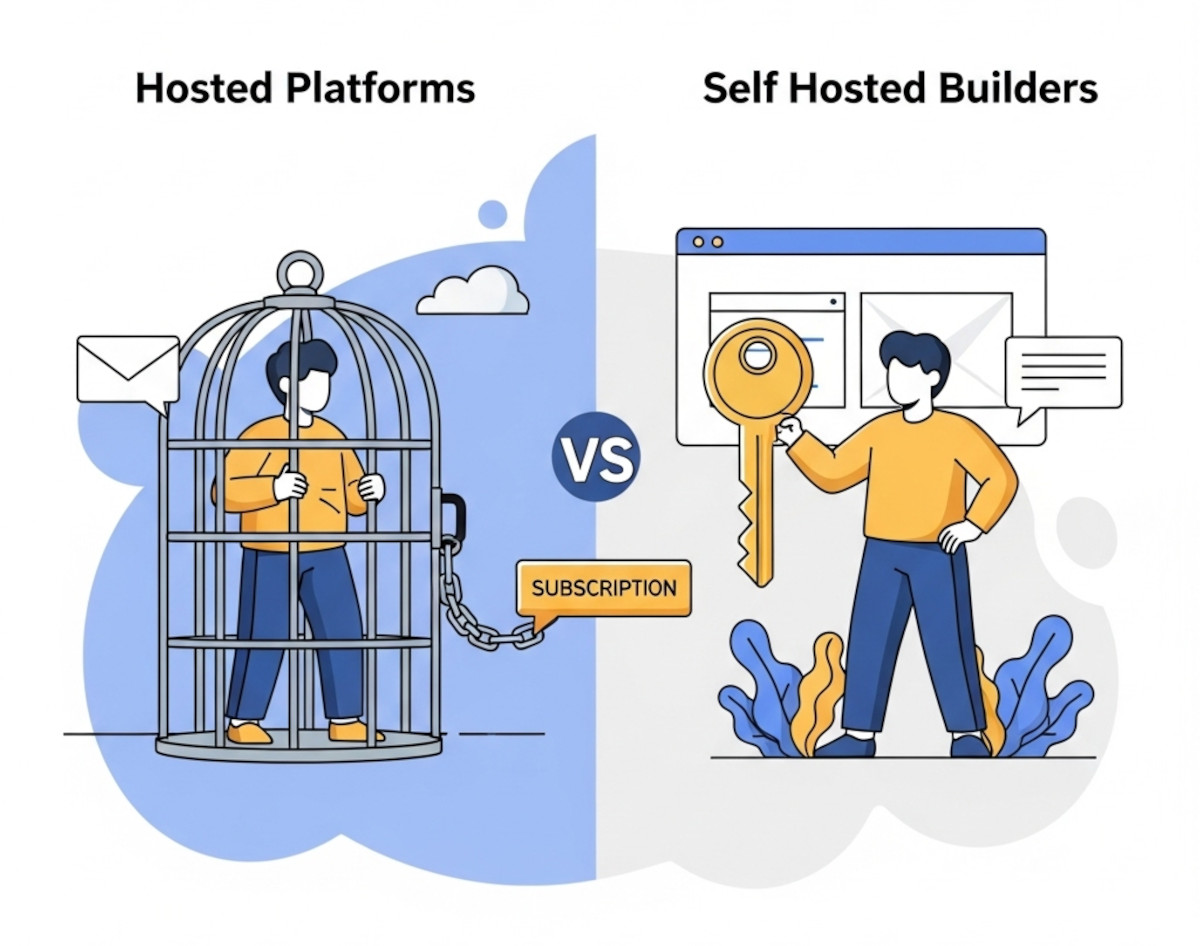
Why So Many Businesses Are Switching from Hosted Platforms to Self-Hosted Builders

Hosted website platforms like Wix, Squarespace, and Shopify have become popular for their drag-and-drop simplicity. But more and more businesses are realizing the hidden costs and limitations that come with these “easy” solutions - and making the switch to self-hosted website builders instead.
Here’s why.
1. You Don’t Really Own Your Website on Hosted Platforms
When you're on a hosted platform, your site is tied to their servers, their pricing, and their limitations. Want to move your site
... Continue reading
Posted in Compare Website Builders
Tagged bloat, clean code, drag-and-drop alternative, drag-and-drop website builder, flexibility, freedom, hosted website builder, limitations, scalability, search engine optimization, self-hosted website builder, seo, Shopify, shopify limitations, slow load times, squarespace, user experience, W3C Markup Validation Service, W3C validation, web hosting choice, website speed, Wix, wix limitations
Leave a comment
How to Promote Your New Website in 2026: A Practical Guide to Getting Your First Real Visitors

Launching a new website is exciting - but publishing it is only the beginning.
One of the biggest misconceptions many new website owners have is believing that traffic automatically appears after launch. In reality, even great websites often receive little to no traffic at first unless they are actively promoted.
This is where many people quit too early.
Search engines take time to trust new domains. Social platforms limit visibility. Communities ignore obvious self-promotion. And publishing random content without a
... Continue reading
Posted in Ask David!, Marketing, Social Media
Tagged authentic engagement, authentic interaction, authenticity, authority, bloat, brand loyalty, build traffic, build trust, clean urls, content creation, content marketing, customer loyalty, customizable urls, discord, discussion boards, easy navigation, engagement, engaging media, facebook group, fast loading times, fast website, fast-loading times, forums, heading tags, high-quality content, instagram, interactive features, internal links, keyword-rich, keywords, leaderboard, leaderboards, linkedin, long-term strategy, marketing, meta descriptions, mobile-friendly, online communities, organic reach, organic traffic, page titles, polls, promote website, reddit, responsive, responsive app, search engine clicks, search engine optimization, search intent, seo, seo basics, seo tips, share insights, short videos, slow load times, social media, social share, surveys, target audience, targeted outreach, tiktok, trust, twitter, user experience, user feedback, visibility, word-of-mouth promotion, x
Leave a comment
What Your Website Visitors Are Secretly Telling You (Through Their Clicks & Bounces)

You’ve spent hours tweaking your website design, crafting the perfect homepage copy, and designing a style you love. But here’s the real question: do your visitors love it too?
You don’t have to guess. In fact, your website visitors are constantly giving you valuable feedback through their actions (or lack of them). From bounce rates to click paths, scroll depth to session duration - every interaction is a clue about what you're doing right... or very wrong.
Let’s decode the
... Continue reading
Posted in Search Engine Optimization (SEO), Website Design, Website Traffic
Tagged bloat, bounce rate, conversions, credibility, design, dwell time, engagement, fast loading times, fresh content, headlines, high-quality content, internal linking, layout, mobile friendly, navigation, ongoing value, page depth, rage clicking, responsive, scroll depth, search engine optimization, search engine ranking, seo, session duration, slow load times, usability, user signals
Leave a comment
Why Should You Care About Your PageSpeed Insights Score If Your Website Loads Fast?

Ask David! Question
My website seems to be loading fast, at least for me. I checked it on desktop and mobile. But I can't get my website to score all in green on PageSpeed Insights. I think it is the website builder I am using. So that's why I am thinking about
... Continue reading
Posted in Ask David!, Search Engine Optimization (SEO)
Tagged cls, conversion omptimization, conversion rate optimization, conversion rates, core web vitals, cumulative layout shift, fast loading times, fid, first impressions, future-proofing, hidden inefficiencies, higher conversions, improved user experience, inp, interaction to next paint, largest contentful paint, lcp, mobile performance, pagespeed insights, psi, search engine optimization, search engine ranking, seo, slow load times, user experience, user-friendly, website performance
Leave a comment