




-
Recent Posts
- “My Partner Wants to Use WordPress Because 50% of the Web Uses It. Help!”
- Does EmDash Solve WordPress’s Problems, or Do You Need UltimateWB?
- How Not to Use AI: Stanford University Can Tell You
- Best Website Builder for SEO: WordPress vs. Wix vs. UltimateWB
- How to Make Sure Your Website Colors Have Enough Contrast for Accessibility
- Mobile-Friendly Website Checklist: 20 Things to Check
- Beehiiv Website Builder Review: The Problem Isn’t the Design – It’s the Lack of Control
- Elementor’s “Angie” AI Is More Than Bloat: Credits, Subscriptions, and a Growing Platform Problem
- How to Pass Google Business Profile Video Verification for Service Businesses
- The Great Deskilling: Why AI Dependence is Turning Developers into Prompt Babysitters
- The Three-Month Fuse: The Everest Forms Pro Attack and Why a Patched Plugin Can Still Put Websites at Risk
- Computer Screen Has Black Bars on the Sides: How to Fix It
- Could AI Make Humans Extinct Within the Next Decade?
- Is Weebly Getting Out of the Website-Builder Business?
- Are You “Leaking SEO” by Linking to Other Websites?
- Wix Harmony Is Now in Google Gemini. So Why Are Users Still Complaining?
- When AI Sounds Confident but Gets It Wrong: The Mount Shasta Rescue
- When AI Agents Start Working Together, Who Is Really in Control?
Categories
Tag Archives: malware
The Hidden Cost of WordPress Security: Why Security Plugins Aren’t the Whole Answer

If you run a website, you know that security isn’t optional. For millions of WordPress users, the immediate reaction to securing a site is to install a security plugin. It’s practically a rite of passage.
But there is a conversation that many developers and web hosts avoid having until it's too late: the real cost of application-level security.
We aren't just talking about subscription fees. We're talking about the hidden performance tax, the administrative burden of constant updates, and the
... Continue reading
Posted in Compare Website Builders, Website Security
Tagged abandoned plugins, backdoor, backups, compatibility issues, cpu, CPU spikes, database, firewall, firewall rules, javascript, maintenance, malcar, malicious code, malware, performance tax, plugin, plugin compatibility issues, plugin vulnerabilities, RAM, security plugin, security stack, solid security, subscription fees, waf, web application firewall, website security, wordfence, WordPress, WordPress plugin vulnerabilities, wordpress security
Leave a comment
Over 1.6 Million WordPress Sites Hit: The OptinMonster and ShapedPlugin Supply Chain Attacks

For years, the gold-standard advice for WordPress website security has been simple: If you want to keep your site safe, stick to major, highly reputable brand names. A massive company has the infrastructure, team, and budget to audit their code and protect your perimeter.
But recent events have exposed a massive flaw in that logic.
When hackers shift from attacking individual sites to targeting the software creators themselves, relying on a big brand's reputation no longer guarantees safety. In fact,
... Continue reading
Posted in Compare Website Builders, Technology in the News, Website Security
Tagged 2FA, Awesome Motive, backdoor, cdn, database, Easy Digital Downloads, javascript, MalCare, malware, optinmonster, php, Product Slider, PushEngage, Real Testimonials Pro, shapedplugin, Smart Post Show Pro, supply chain attacks, TOTP, updraftplus, vulnerability, woocommerce, wordfence, Wordfence Login Security, WordPress, WP 2FA
Leave a comment
Why Google Deindexed 99% of My E-Commerce Site Overnight – And How to Fix “Crawled – Currently Not Indexed”

You log into Google Search Console (GSC) and see a vertical cliff. A WooCommerce (why didn't you use UltimateWB?!) store that held 5,000+ stable product URLs for months is suddenly down to just a handful of indexed pages. Your core catalog is completely gone. At least your homepage is left standing, you say to yourself.
You run the standard technical triage checklist:
- Robots.txt? Clean.
- Noindex tags? None. Everything is set to index, follow.
- Canonical tags? Correct and self-referencing.
Posted in E-commerce, Search Engine Optimization (SEO)
Tagged 301 redirect, algorithm changes, algorithmic filtering, bloat, bottlenecks, canonical tag, canonical tags, core updates, crawl priorities, crawl stats, crawled, crawled not indexed, database bottlenecks, deindexed, duplicate content, fast website, google algorithm penalties, Google Search Console, Googlebot, gsc, hpos, html, http errors, indexed, indexing, javascript, malware, noindex, noindex tag, pagespeed insights, performance bottlenecks, quality content, rendered html, robots.txt, security flags, seo, server log, site-wide quality signals, sitemap, soft 404, submit sitemap, technical penalty, technical seo, test live url, thin content, time to first byte, ttfb, unique value, url inspection tool, visibility, woocommerce, WordPress
Leave a comment
The 30-Minute Job Interview That Steals Your Entire Hard Drive

If you're looking for freelance development work on Reddit, LinkedIn, Upwork, or similar platforms, be careful. Scammers are increasingly disguising malware as coding assessments and technical interviews. What appears to be a simple GitHub repository for a 30-minute coding test may actually be an attempt to get you to execute malicious code on your own machine.
The setup looks completely legitimate. A recruiter or startup founder reaches out with what appears to be a freelance opportunity. The interview
... Continue reading
Posted in Technology in the News
Tagged coding, developer, downloads, freelancer, GitHub, linkedin, malicious code, malware, phishing, plugins, reddit, reputation, sandbox, scammer, tech interviews, third-party code, third-party plugins, trust, upwork, virtual machines, vm
Leave a comment
The WordPress Backdoor Scandal: Why 30+ “Trusted” Plugins Just Turned Malicious

This recent security breach in the WordPress ecosystem is a massive wake-up call for website owners. A portfolio of over 30 plugins was sold to a new owner who immediately weaponized them with backdoors.
If you use UltimateWB, you are in a much safer position than the average WordPress user - and here is why.
The Attack: What Happened?
A portfolio of 30+ plugins (formerly under "WP Online Support," now "Essential Plugin") was sold on Flippa for a six-figure
... Continue readingCan one hacked website lead to others being compromised on Shared Hosting?

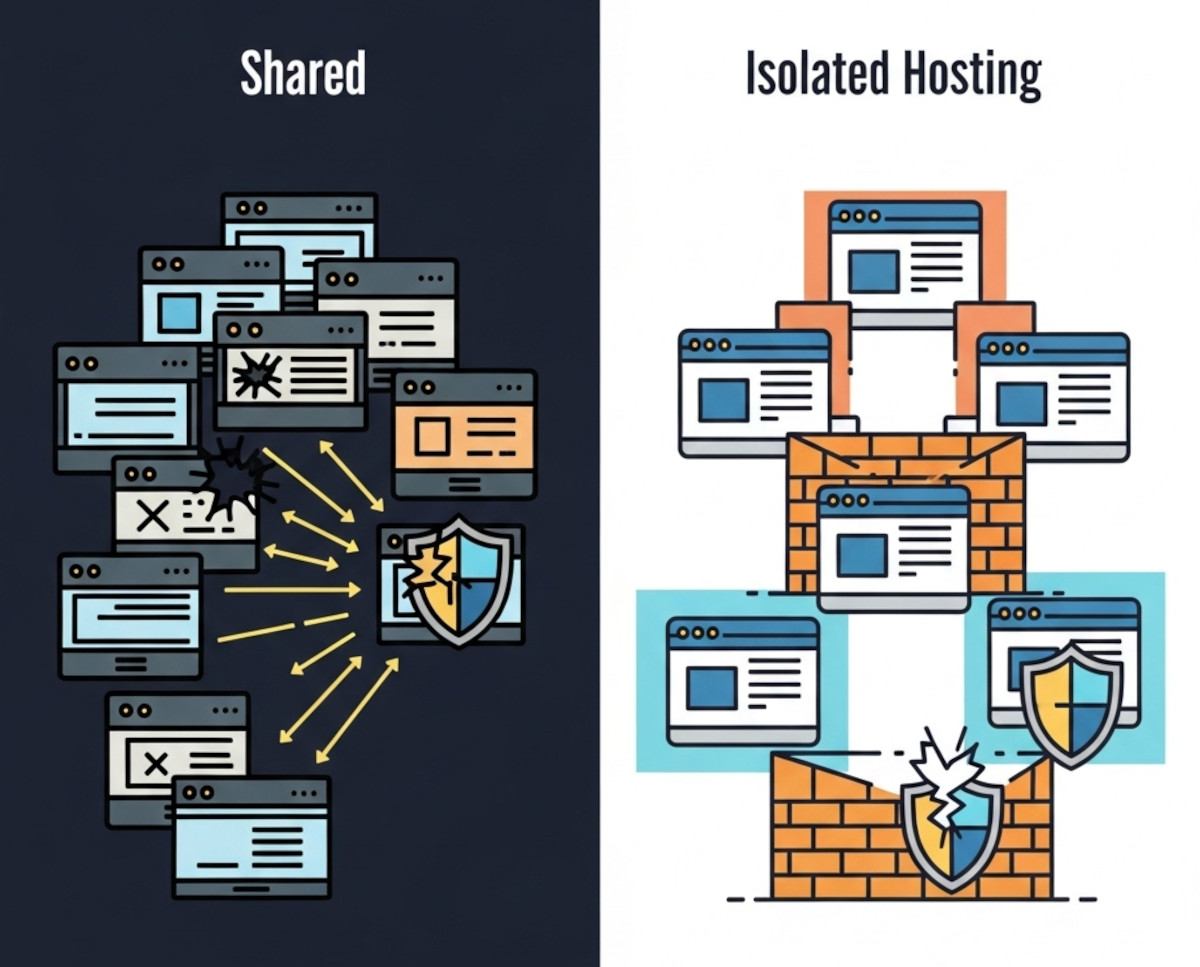
Short answer: Yes - if you're on traditional shared hosting, a hacked website on the same server can put yours at risk too.
That’s a big reason why we don’t do shared hosting here at UltimateWB.
🔓 The Problem with Shared Hosting
With typical shared hosting providers, like many of the big-name hosts, multiple websites are stored together on the same server and under the same environment. This setup shares system resources, file space, and sometimes even user
... Continue reading
Posted in Ask David!, Web Hosting
Tagged file permissions, hacked website, hosting comparison, isolated hosting accounts, malware, safe website builder, secure website hosting, secured hosting, security, security issues, security vulnerabilities, shared hosting, shared hosting risk, speed, stability, trust, ultimatewb cloud hosting, ultimatewb web hosting, web hosting security, website security
Leave a comment
Justice Department and FBI Lead International Operation to Eradicate PlugX Malware from U.S. Computers

The Justice Department and FBI recently concluded a multi-month operation, successfully removing the PlugX malware from over 4,200 U.S.-based computers. This court-authorized initiative targeted the malware deployed by Chinese state-backed hacker groups, "Mustang Panda" and "Twill Typhoon."
Understanding PlugX
PlugX is a sophisticated malware used by Mustang Panda since 2014 to infiltrate and control victim computers, stealing sensitive data. It has affected governments, businesses, and dissident groups across the U.S., Europe, and Asia. Despite previous warnings, many users were unaware
... Continue readingWhat is the significance of web hosting in SEO?

Web hosting is the backbone of your online presence, and it plays a critical role in your SEO strategy. While it's not a direct ranking factor, it significantly influences factors that do impact your search engine rankings.
Here's how web hosting affects SEO:
1. Website Speed:
- Faster Loading Times: A reliable web host ensures your website loads quickly.
- Improved User Experience: Fast-loading websites keep visitors engaged, reducing bounce rates.
- Higher Search Engine Rankings: Search engines
Posted in Ask David!, Web Hosting, Website Security
Tagged bounce rate, conversions, cyber threats, cyberattacks, engagement, fast loading times, future-proofing, hackers, malware, ranking factor, scalable, search engine ranking, seo, seo ranking, server, ssl, traffic, uptime, user experience, web hosting
Leave a comment
What are the most common WordPress vulnerabilities?

WordPress, although widely used, is not particularly easy or user-friendly and can be susceptible to various security vulnerabilities. Here are some of the most common ones:
Weak Passwords and Login Credentials:
This tops the list because it applies not just to WordPress but to any online system. Hackers can easily exploit weak passwords through brute-force attacks.
Outdated Software, Plugins, and Themes:
Outdated software often contains known vulnerabilities that hackers can exploit. Regularly updating WordPress core, themes, and plugins is crucial.
... Continue reading
How to remove Google redirect virus from your computer easily & free!

If your computer caught the Google redirect virus - where you search for something on Google, and then instead of the search engine taking you to the website you click on, it takes you to another page instead, with advertisements and spam - you can easily fix it and remove the virus from your computer - FREE!
You don't need a computer technician, just download the TDDS remover from Symantec. After downloading the file to your computer, double click on
... Continue reading