


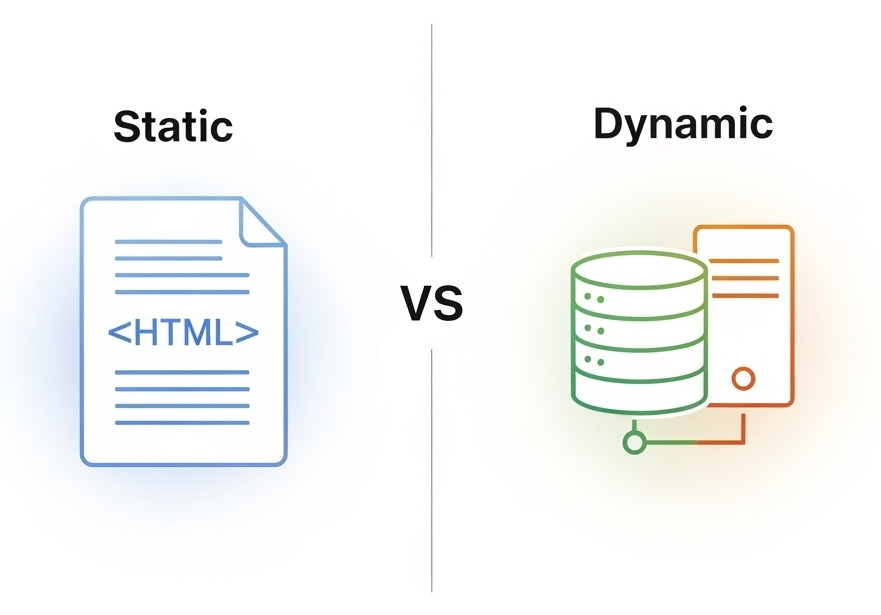
Choosing between a static and dynamic website is one of the most important decisions you’ll make when building a website. Each method has its pros and cons, but if you’re looking for speed, flexibility, and long-term ease of use, dynamic websites are usually the better choice – even for simple informational sites. However, not all dynamic sites are created equal, and poor backend coding or a clunky website builder can lead to major performance issues.
Let’s break down the key differences between static and dynamic websites and help you decide what’s right for you.
🔹 What Is a Static Website?
Static websites are made up of fixed .html or .htm files. The content on each page is hardcoded, meaning the page displays exactly what’s written in the file – no database, no dynamic content generation.
✅ Pros of Static Websites:
- Fast load times (minimal server processing)
- Simple to host and secure
❌ Cons of Static Websites:
- Hard to maintain: Want to update a header, footer, or navigation menu? You have to edit each page manually.
- Time-consuming updates: Adding a new page means editing multiple files.
- Not scalable for growing websites or frequent changes
For example, if you want to update your site’s navigation or footer, you’d need to open and edit every single page – wasting time better spent on content creation or SEO improvements.
🔹 What Is a Dynamic Website?
Dynamic websites are built using server-side technologies like PHP, Node.js, Python, or Ruby, and content is typically pulled from a database. Pages are generated on the fly based on templates and user interaction.
✅ Pros of Dynamic Websites:
- Easy updates: Update the header, navigation, or footer in one place, and it applies site-wide.
- Highly scalable: Ideal for blogs, business sites, marketplaces, and membership platforms.
- CMS integration: Dynamic website builders and content management systems (CMS), like UltimateWB, make development fast and intuitive.
⚠️ Cons (Only If Done Wrong):
- Possible slower load times if built with bloated or poorly optimized code
- More complex than static sites, but worth it when using the right tools
With a well-coded dynamic website and good web hosting, your site can load just as fast – if not faster – than a static site.
🚫 When Dynamic Websites Can Go Wrong
The dynamic format itself isn’t the problem – it’s how it’s implemented.
Some dynamic website builders produce excessive or inefficient code that bogs down performance. Before committing to a platform, check:
- Real-world websites built with it
- Page load times (use tools like Google PageSpeed Insights or GTmetrix)
- Hosting performance, since poor hosting can slow down any website, static or dynamic
With a builder like Ultimate Web Builder, you get clean, optimized code, and automation tools that make updating your website fast and scalable.
✅ Final Thoughts: Which Is Better?
For most use cases, a dynamic website is the better long-term investment. It saves you time, scales with your business, and allows for modern features like login systems, e-commerce, and content management.
If you’re building a personal homepage or a one-page site with no updates, static might be fine – but in nearly all other scenarios, dynamic wins.
💡 Pro Tip:
Use a dynamic website builder that is optimized for speed and flexibility. UltimateWB, for example, lets you create scalable websites with fast load times and powerful automation features – without needing to code from scratch.
Get the details: What’s the Best Website Builder for SEO?
Ready to design & build your own website? Learn more about UltimateWB! We also offer web design packages if you would like your website designed and built for you.
Got a techy/website question? Whether it’s about UltimateWB or another website builder, web hosting, or other aspects of websites, just send in your question in the “Ask David!” form. We will email you when the answer is posted on the UltimateWB “Ask David!” section.