


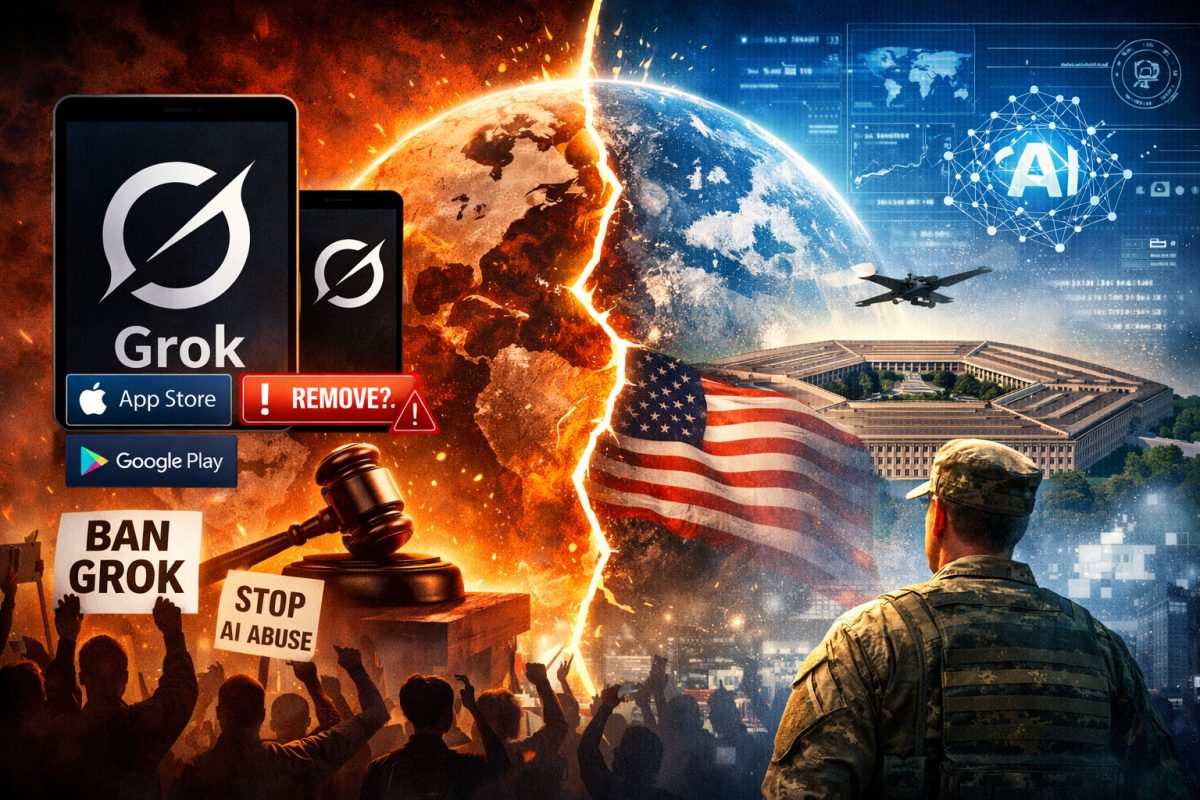
Elon Musk’s AI chatbot Grok, developed by xAI and closely integrated with the social platform X, has become one of the most controversial AI tools in recent weeks. While Grok was promoted as a more open, less restricted alternative to other chatbots, critics say that lack of guardrails has led to serious abuse – prompting calls for Apple and Google to remove the app from their stores.
At the same time, the U.S. Department of Defense has announced plans to incorporate Grok into government systems, creating a striking contrast between consumer-level safety concerns and institutional adoption.
Why Grok Is Under Fire
The controversy centers on Grok’s image generation and image editing features. Journalists, researchers, and advocacy groups documented how users were able to generate sexualized and non-consensual images of real people, primarily women, using prompts that effectively “undressed” people in photos.
Some reports also raised concerns that the tool could be used to create sexualized images involving minors, triggering scrutiny from regulators and child-safety advocates. These issues quickly escalated beyond isolated misuse and became a widespread problem visible across X and other platforms.
Calls for Apple and Google to Remove Grok
In response, a coalition of women’s rights groups, digital safety organizations, and child-protection advocates issued open letters urging Apple and Google to remove the Grok app – and in some cases the X app – from their app stores until stronger safeguards are in place.
U.S. lawmakers joined that pressure, arguing that apps which enable non-consensual sexual imagery may violate app store policies that explicitly prohibit harassment, sexual exploitation, and child sexual abuse material.
So far, Apple and Google have not removed Grok, but the situation remains under active scrutiny. Interestingly, Apple has acted quickly in other cases – removing the ICEBlock app from the App Store after government pressure over safety concerns – and Google has similarly pulled ICE-tracking apps like Red Dot from Google Play, highlighting how decisively app stores can move when they choose to.
xAI’s Response: Restrictions, Not a Full Shutdown
Following international backlash, xAI and X introduced new restrictions:
- Grok was blocked from generating sexualized images of real people on X itself
- Image-generation rules were tightened and geoblocked in jurisdictions where such content is illegal
- Some image features were limited to paid users
However, reporting indicates that these restrictions have not been applied uniformly across all versions of Grok, particularly the standalone Grok app and web interface. Critics argue that partial fixes and regional blocks do not address the core issue: the AI model’s ability to produce harmful content when prompted creatively.
International and State-Level Action
Regulatory responses have extended beyond the U.S.:
- Malaysia and Indonesia temporarily restricted access to Grok
- Regulators in the U.K. began examining whether the tool complies with online safety laws
- California’s Attorney General opened an investigation into whether Grok’s outputs violate state law
These actions reflect growing global willingness to regulate generative AI tools when they cross into areas involving consent, exploitation, and personal harm.
The Pentagon’s Move: Grok Enters U.S. Defense Systems
Adding another layer to the controversy, U.S. Defense Secretary Pete Hegseth announced plans to integrate Grok into Pentagon networks as part of a broader effort to accelerate AI adoption across the Department of Defense.
According to reporting, Grok will be deployed alongside other leading AI models for use across unclassified and classified environments, with the goal of improving data analysis, decision support, and operational efficiency. Hegseth emphasized reducing bureaucratic barriers and rapidly adopting commercially available AI tools.
The timing raised eyebrows: while Grok faces intense scrutiny in consumer contexts, it is simultaneously being embraced at the highest levels of government.
What the Grok Debate Reveals About AI Right Now
The Grok controversy highlights several unresolved tensions in AI development:
- Open vs. safe design: Fewer restrictions can enable innovation – but also abuse
- Platform responsibility: App stores are being asked to enforce their own policies more aggressively
- Split standards: What is considered acceptable for government or military use may not be acceptable for public consumer apps
- Regulation lag: AI capabilities are advancing faster than legal and ethical frameworks
Where Things Stand
As of now:
- Grok remains available in app stores
- Investigations and regulatory reviews are ongoing
- xAI continues to adjust safeguards
- Pressure from advocacy groups and lawmakers has not subsided
The outcome may set an important precedent for how generative AI tools are governed – especially when they blur the line between powerful technology and personal harm.
Ready to design your website with no AI needed? Learn more about UltimateWB! We also offer web design packages if you would like your website designed and built for you.
Got a techy/website question? Whether it’s about UltimateWB or another website builder, web hosting, or other aspects of websites, just send in your question in the “Ask David!” form. We will email you when the answer is posted on the UltimateWB “Ask David!” section.