






-
Recent Posts
- Etch Pre-Sale Promises: What’s Been Delivered and What’s Still Missing?
- Why Reddit Threads on Website Builders Miss the Point (And What to Look For Instead)
- Epileptic Woman Dies After Using ChatGPT for Medical Advice; Family Sues OpenAI
- Best Practices for Image Filenames and Alt Tags: A Quick SEO Checklist
- Best Website Builder for a Web Development Business: Build Your Own Website and Client Websites
- How to Make a Website Without AI for Free
- Is Wix Safer Because It Doesn’t Use PHP? Wix Security Vulnerabilities Tell a Different Story
- Rank Math PRO Supply Chain Attack: Why Updating the Plugin May Not Be Enough
- How to Safely Upgrade Legacy PHP (5.6, 7.0–7.3) to Modern, Supported Versions
- Critical PHP Vulnerabilities (“PHP2Shell”): What You Need to Know & Which Platforms Are Affected
- What Happened to GeoCore Classifieds? From Commercial Software to Community Project
- Why Vibe Coding Isn’t the Only Way to Build a Website Without Monthly Fees
- How to Create a Simple Website to Receive Client Files and Scheduling Requests
- Can You Fork a Paid WordPress Plugin Instead of Paying the Subscription?
- When Google Decides Not to Index a Page, Can You Change Its Mind?
- The Events Calendar Alternative: Why Pay More for WordPress Plugins You Don’t Need?
- Firefox Is Starting Automatically When You Log In? Here’s How to Stop It
- Wix vs. WordPress vs. UltimateWB: Which Is Best for a Personal Training Business?
Categories
Search Results for: header tags
Why You Should Remove Redundant Header Tags from Your Web Pages

For a long time, SEO tools and platforms like Bing Webmaster Tools will flag this message:
“Remove redundant <h1> tags from the page source, so that only one <h1> tag exists.”
Why? Because having multiple <h1> tags can confuse both search engines and users about what your page is really about - even though modern search engines are more flexible than they used to be.
📌 What An <h1> Tag Is
The <h1> tag is the main heading of your
... Continue readingBest Practices for Image Filenames and Alt Tags: A Quick SEO Checklist

When optimizing your website for search engines, it's easy to focus on keywords, page titles, meta descriptions, and site structure while overlooking the images on your pages.
Image filenames and alt text are simple details you can get right before publishing. Descriptive filenames help provide context about an image, while well-written alt text makes meaningful images accessible to visitors using screen readers and helps search engines understand their content.
Neither is a shortcut to higher rankings, but both are worth
... Continue reading
Posted in Photos Management, Search Engine Optimization (SEO)
Tagged accessibility, accuracy, alt tag, clarity, decorative images, google images, image filename, images, keyword stuffing, keywords, meta descriptions, organic traffic, page titles, robots.txt, search engine optimization, seo, webp, webp converter, website traffic
Leave a comment
Can you still get ranked just as well with a one-page website than with a multi-page website? i.e. with the proper use of h1 headers, etc.?

Yes, you can absolutely achieve good SEO rankings with a well-optimized one-page website. While multi-page websites offer certain advantages, such as targeting a wider range of keywords and providing a more structured user experience, a single-page website can be equally effective if done right.
In fact, in some cases, a one-page website can even have an advantage over a multi-page website. Here's 2 main reasons why:
1. User Experience: A one-page website can be more user-friendly, as visitors don't
... Continue reading
Posted in Ask David!, Search Engine Optimization (SEO)
Tagged backlinks, clean urls, clear content, concise, concise content, fast loading times, focus, header tags, headers, high-quality content, internal linking, keyword placement, keywords, meta description, mobile friendly, multi-page website, one-page website, optimized urls, organic traffic, page title, responsive, search engine optimization, search engine ranking, seo, user experience, user friendly
Leave a comment
Should you use H1 Tags for better SEO, search engine ranking, and more organic traffic?

The short, quick answer is: If you want...you don't have to have H1 tags, you can have 1 H1 tag per page, you can have multiple H1 tags per page - having H1 tags it is not a determining factor on how well your website does with the search engines. Here's what Google's John Muller said about it in a Google Webmaster hangout:
"You can use H1 tags as often as you want on a page. There's no limit
... Continue readingPaying $10,000 a Month for SEO? Here’s How to Tell If You’re Getting Your Money’s Worth

SEO can be expensive.
It's not uncommon for businesses to pay anywhere from a few hundred dollars to well over $10,000 per month for SEO services. Large companies in highly competitive industries often spend even more.
So is that money well spent?
Sometimes, absolutely.
Other times... not so much.
The difference usually isn't the price - it's whether the work being done actually moves the business forward.
A recent discussion on an online marketing forum caught our attention. An in-house
... Continue reading
Posted in Search Engine Optimization (SEO)
Tagged authority, backlinks, bloat, clean code, crawl errors, duplicate content, fast website, google analytics, Google Search Console, high-quality content, internal links, keyword tracking, mobile usability, mobile-friendly, page speed, search intent, search intent match, seo, seo packages, seo pricing, seo services, structured data, technical seo, third-party plugins, user experience
Leave a comment
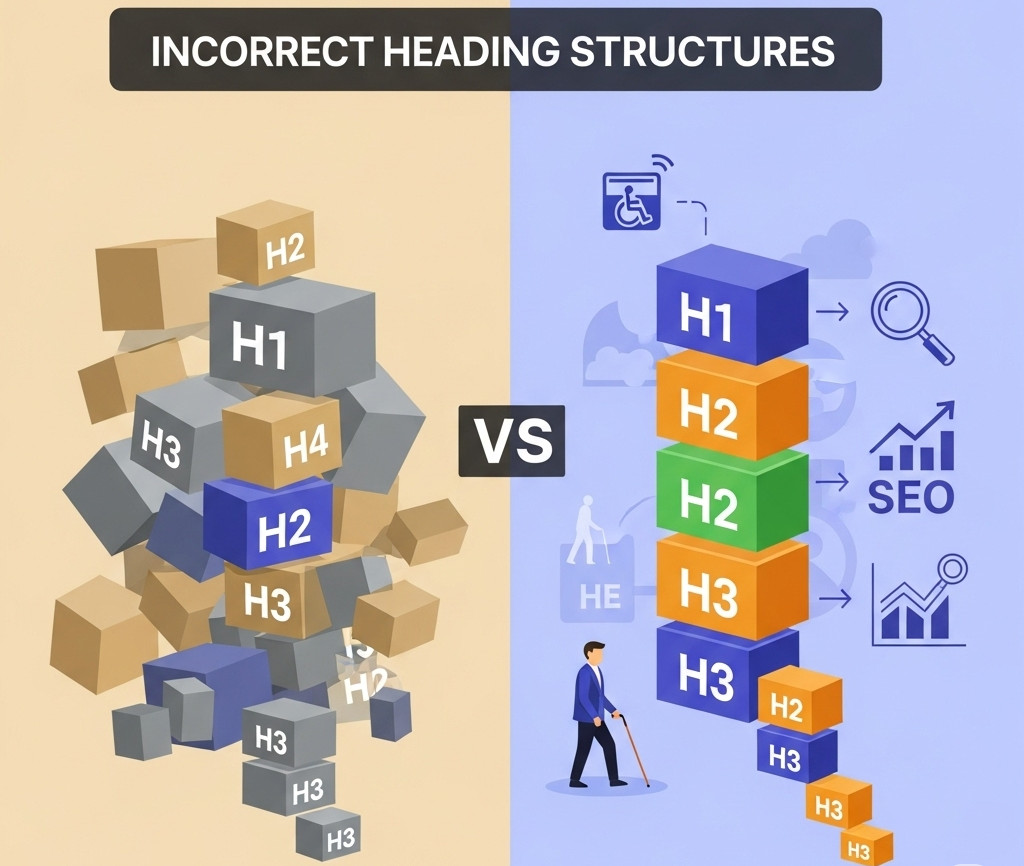
Why an H1 Shouldn’t Come After an H3 – And Why It Matters for SEO and Accessibility

When you're building a website, it's easy to focus on how things look - but how your site is structured under the hood is just as important. One commonly overlooked issue? Incorrect heading order.
We recently came across a website where the first visible heading was an <h3>, and the <h1> appeared after it. While it might not break the layout or cause visible problems, this kind of structure can negatively impact both SEO and accessibility. Here’s why heading
... Continue reading
Posted in Accessibility, Search Engine Optimization (SEO), Website Design
Tagged accessibility, accessibility compliance, assistive technologies, better indexing, clean code, compliance, easy navigation, focus, header, heading, heading order, heading tags, hierarchical structure, hierarchy, indexing, keyword relevance, logical hierarchy, main heading, page quality signals, performance, roadmap, screen readers, search engine optimization, search engine ranking, search engine results, search engines, semantic markers, seo, seo signals, snippets, standards-compliant, subheadings, usability, user experience, visibility, web standards, website structure
Leave a comment
What Factors Does Google Consider When Ranking Websites?

Google's search algorithm, known as PageRank, is a complex system that aims to rank web pages based on their relevance and importance. While the exact details are kept confidential, here are some of the key factors that Google considers:
1. Content Quality:
- Relevance: Does the content accurately and comprehensively address the user's search query?
- Originality: Is the content unique and free from plagiarism?
- Depth and Expertise: Does the content provide in-depth information and demonstrate expertise in the subject
Posted in Ask David!, Search Engine Optimization (SEO)
Tagged backlinks, domain authority, expertise, fast loading times, google algorithm, google my business listing, google pagerank, google search engine ranking, header tags, high-quality content, https, image optimization, in-depth info, local seo, meta descriptions, mobile friendly, on-page seo, organic traffic, originality, page authority, page speed, pagespeed insights, responsive, responsive app, search engine optimization, search engine ranking, seo, sleek, ssl, technical seo, title tags, user experience, user friendly, user signals, webp, webp converter
Leave a comment
How can I start SEO on my own website?

That's a good question and an important one - marketing is key to any business, and for websites a big part of it is SEO! Here is a guide we have put together...
Starting Your SEO Journey: A Beginner's Guide
SEO, or Search Engine Optimization, is the practice of improving a website's visibility and ranking in search engine results pages (SERPs) like Google. Here's a basic roadmap to get you started:
1. Keyword Research:
- Identify relevant keywords:
Posted in Ask David!, Search Engine Optimization (SEO)
Tagged alt tags, alt text, backlinks, bloat, clean code, code bloat, fast loading times, keyword research, local seo, long-tail keywords, mobile-friendly, off-page seo, on-page seo, optimize images, organic traffic, responsive, responsive app, search engine optimization, search engine optimization tips, search engine results pages, seo, serps, sitemap, sitemap generator, social media, technical seo, website traffic, xml, xml sitemap
Leave a comment
What Makes Website Content “High-Quality”? 6 Essential Search Standards

"Ask David!" question: "How do I know if my website content is 'high-quality content'? I want to rank high in Google and get a lot of website traffic."
When managing a site, creating content that actually ranks on search engines and converts visitors comes down to one core factor: quality. Search engine algorithms - specifically Google’s Search Essentials and Quality Rater Guidelines - focus heavily on Experience, Expertise, Authoritativeness, and Trustworthiness (E-E-A-T).
Whether you are launching a new site or
... Continue reading
Posted in Ask David!, Search Engine Optimization (SEO), Web Content
Tagged accuracy, alt tags, and Trustworthiness, ask david, authoritativeness, build trust, clarity, clean code, E-E-A-T, engaging ontent, experience, expertise, factuality, fast website, fresh content, Google’s Search Essentials, headings, high-quality content, high-quality images, interactive, internal links, keyword stuffing, polls, Quality Rater Guidelines, search engine optimization, search intent, seo, subheadings, target keywords
Leave a comment
How to Optimize Your Website for Both Search Engines and Users
Creating content that appeals to both search engines and users is crucial for any website aiming to boost visibility and engagement. A well-optimized webpage ensures that search engines understand its relevance and quality, while also providing users with valuable, engaging, and accessible information. Here are some key strategies to achieve this balance:
1. Conduct Keyword Research
Before you even start writing your content, it’s essential to understand what your target audience is searching for. Keyword research helps identify the
... Continue reading